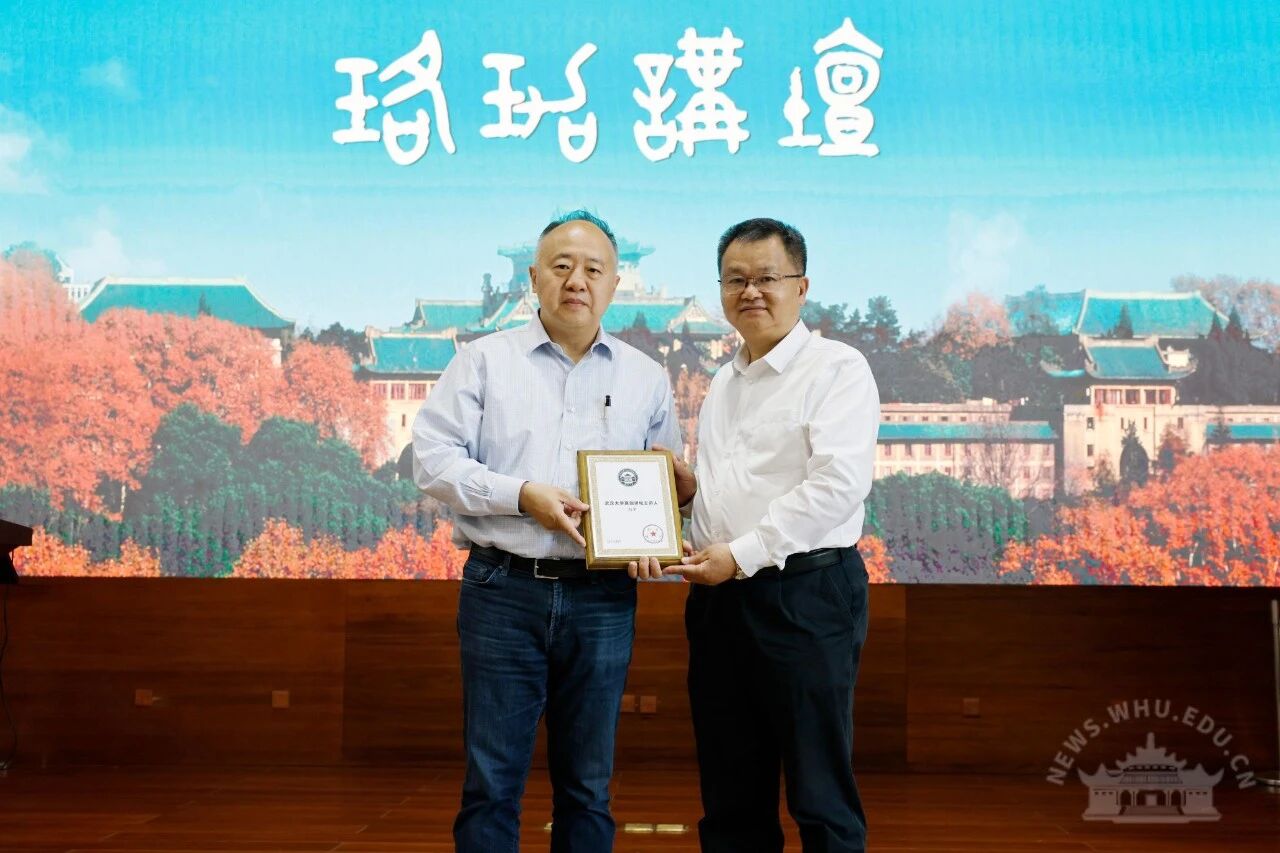
On May 12th, Academician Liu Jun from the Department of Statistics and Data Science at Tsinghua University visited Wuhan University's Luojia Forum as a guest speaker. Wuhan University President Academician Zhang Pingwen attended the event and presented him with the Luojia Forum commemorative plaque.
Starting from the research trajectory of Geoffrey Hinton, Liu Jun explained the key factors behind the resurgence of artificial intelligence. He introduced the research history, development process, and key figures of Monte Carlo methods, providing detailed explanations of recent research directions and specific examples in this field. As a numerical computation technique based on random sampling, Monte Carlo methods encompass various approaches—including reparameterization, diffusion sampling, resampling, optimal transport, and variational approximation techniques—and involve a rich array of algorithms such as Sequential Monte Carlo (SMC) and Markov Chain Monte Carlo (MCMC). Monte Carlo methods have become crucial tools for handling optimization and integration problems, holding extensive applications and significant importance in the field of artificial intelligence.
Professor Yang Zhijian, Vice Dean of the Wuhan Institute of Mathematics and Intelligent Research, presided over the forum. During the interactive Q&A session, faculty and students actively raised questions. Liu Jun engaged in discussions covering the details of Monte Carlo methods, their integration with AI development, the importance of statistics, and approaches to learning methodologies.
Reprinted from Wuhan University News Network.